frevvo v9 is no longer supported. Please visit Live Forms Latest for our current Cloud Release. Earlier documentation is available too.
Using Flows
- Former user (Deleted)
- Megan Ellis

Examples of Approving/Rejecting workflow tasks and Important topics about the behavior of workflows are discussed below.
- Cloud customers will see several pre-built workflow and form templates when you sign in to your account. All workflow templates in the Cloud come with short Guided Tours. that automatically launch, and are intended to show you how to run the workflow.
- On-demand help about the
flow properties is also available.
Refer to Testing Workflows for information about testing them.
On This Page:
Invalid Form Notification for Users
frevvo provides a method to show validation errors at the time of submission. Click on the Continue or Finish button in a flow that contains invalid data or required fields that are empty and the invalid controls are highlighted with a background color. Refer to this documentation for the details.
Unsaved Changes Warning Message
Users, filling in a lot of data in a long flow, may loose that data if they close the browser/browser tab without saving or submitting. Browser messages will popup to confirm or cancel the window\tab closing action to avoid the loss of data. Refer to Unsaved Changes Warning Message topic to see how this feature works.
Designers should consider the Save on Navigate feature for workflows if you want to save entered data when the browser is closed before Saving or Submitting.
Approval Flows
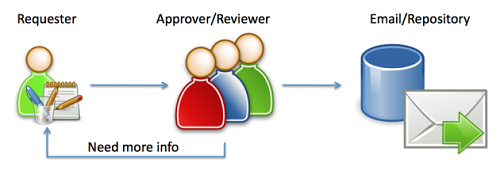
Approval workflows are very easy to automate in . The requester fills out the original form (or set of forms) electronically and the flow is then routed it to the appropriate person or persons according to the desired business scenario. They’re notified with an email and can take action instantly using any device e.g. instant approval using a smart phone. E-signatures are collected and pdfs can be generated along the way.
offers multiple integration options so you can save your data.
Approving a Task
Reviewing a task for approval is very easy in using the Task List. The approver can use the
 Quick Approval or the
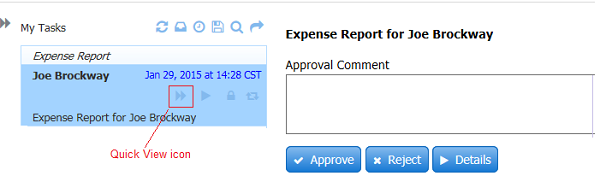
  Perform icons to display the approval step. Quick Approval displays a Quick View of the task without displaying the entire form. It allows the user who's responsibility it is to review the task (manager, supervisor, reviewer etc.) to add a comment, approve or reject, sign and pass it to the next user in the flow. This works well on mobile devices. Of course, if the approver wants to see the entire form they can click the Details button.
Follow these instructions to approve a task for the flow that you downloaded:
- Access the flow from your space. Log in to
- Click the appropriate tab then select the flow from the choices.
- Run the flow to a step that requires an approval. - (manager, VP, Payroll) .
- Check the email for any user whose role is manager. Click on the link in the email.
- Log into
- Access the task by clicking the Important Items tab and then click on the Task List.
- For a quick approval, click the Quick View icon. If the task does not have a Quick View icon, click the Perform icon. Notice the task is now locked so no one else can review it.
- Here is an example of Quick Approval for the Expense Statement flow. If the approver wants to see the Expense Statement first, then click the Details button.
- Sign if required. If you clicked on the Quick View icon, click the Approve button. A "Please Wait" message flashes and the "Task successfully approved" message displays. Logout.
- For a quick approval, click the
- If you clicked on the Perform icon, fill in the required fields, click the button on the screen to advance to the next step or complete the flow. The label of the "Continue" button may differ as this is customizable by the flow designer. The task disappears from the task list.
- If the flow has additional steps, then check for a task notification email with a link to the task, for a user who can perform that step, then login if required. For example, the third step in the Expense Report flow is performed by a user with the role of Finance and the final step is performed by a user with the role of CFO.
- Access the task by clicking the Important Items tab and then click on the Task List. Approve each step.
- Complete the remaining steps for the flow. Logout.
Rejecting a Task
A non-admin user can send a task back to a previous step by clicking the Reject button. The Reject button is configurable by the designer so all steps in the flow may not have one.
Let's consider an Expense Report workflow where the first step is performed by the employee, then it is routed to the employee's manager for approval/rejection. If approved, the workflow is then routed to the Payroll department for final processing. A Reject button has been configured for the Manager and Payroll steps and email notification is turned on for all participating users.
Employee William accesses his company's HR portal and logs in to . He fills out and submits his Expense Report then he logs out of
.
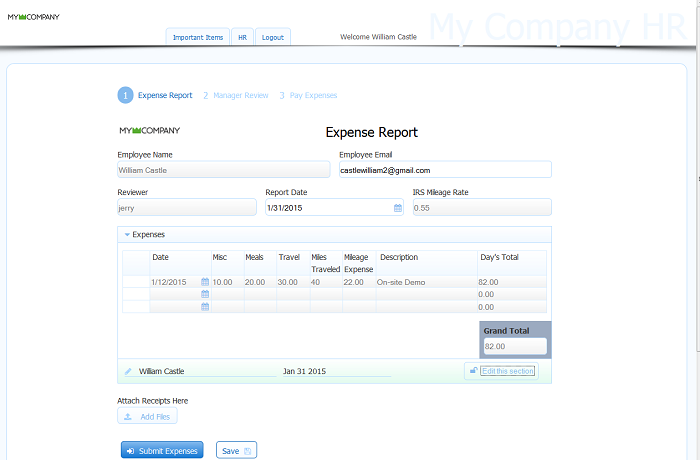
William's manager, Jerry receives a task notification email informing him there is a task on his task list that requires his attention.
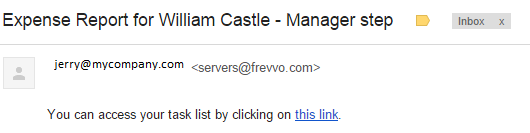
Jerry clicks the link in the email, logs into from a mobile device and clicks the the
Quick View icon.
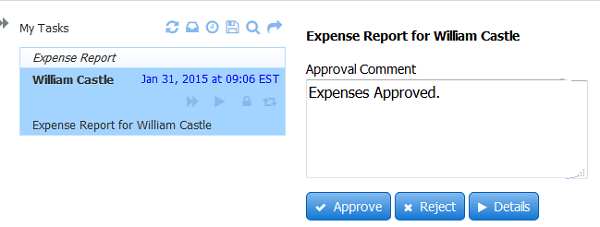
Jerry adds a comment, then approves the task by clicking on the Approve button. The "Task successfully approved" message displays and Jerry logs out of .

All users who work in the Payroll department receive a notification email and the workflow is routed to their task lists.
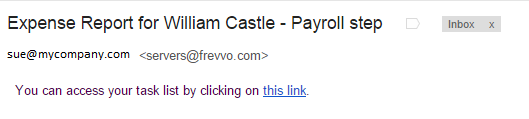
Sue, who is a Payroll department employee, clicks the link in the email, logs into , performs the task and notices that William neglected to attach images of his receipts.
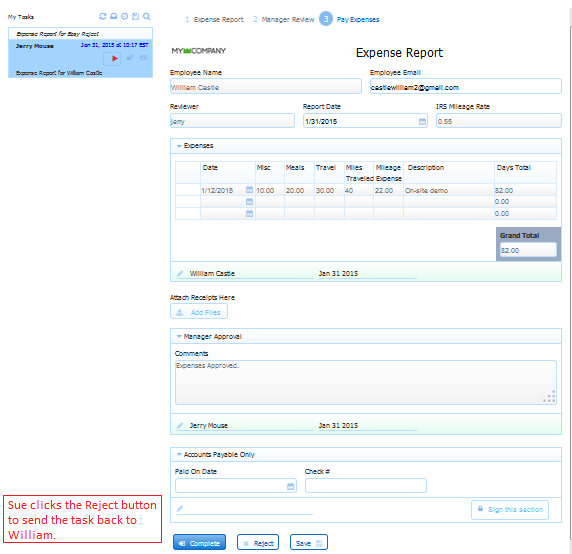
Sue clicks the Reject button. She rejects the task back to the step in the flow performed by William Castle by selecting that step from the dropdown. Then she provides the reason for the rejection.
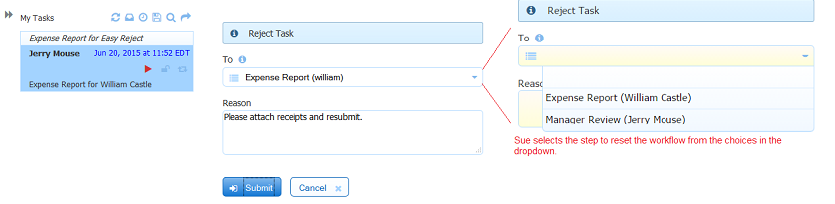
She clicks Submit on the Rejection screen and sees the "Task successfully rejected" message.

The task is removed from Sue's task list and she logs out. William receives a customized email asking him to attach the receipts.

William logs into and accesses the task from his Task List.
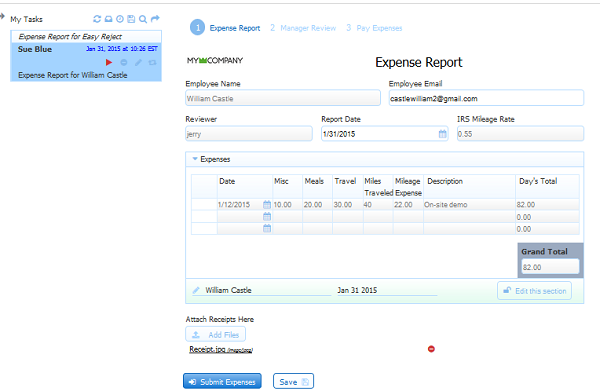
He uploads the receipts then resubmits the Expense Report. The workflow is routed to Jerry, who can reject the task and send it back to William or approve it. If approved, the workflow will once again be routed to the Payroll department employees. Now that the receipts are attached, the first employee in Payroll to perform the task can complete the final processing of William's Expense Report.
Searching for Tasks
Click the  icon on the Task List to search for a form you have saved and want to continue, that you have submitted in the past, or to search for a flow you have participated in. You can narrow your search to specific forms or flows, a date range when you performed a task or only tasks that ended with errors. You can check one or more task states (Saved, Submitted, WAITING, PENDING, ABORTED) to include/exclude tasks from the search results.
Search will only show tasks that the user has participated in.
Select a Form/Flow from the dropdown and Filter Form/Flow by Data" table becomes visible and enabled. You can use this table to optionally select fields that are set up as Searchable Fields in your form/flow by the designer as search criteria.
The Filter Form/flow by data section of the Search screen allows you to optionally setup additional search criteria using the Searchable Fields configured for the form/flow. The Condition column provides the available conditions based on the type of field, and the Value column allows you to enter matching values. The filter logic can be edited using ANDs and ORs, etc.
Condition Column
The Condition column choices depend on the data type of the selected field. The data types and their corresponding options are shown in the table.
| Data Type(s) | Conditions Available in the Dropdown List |
|---|---|
| Date, Time, Date/Time | is equal to |
| is not equal to | |
| is after | |
| is before | |
| is on or before | |
| is on or after | |
| is within last | |
| contains a value | |
| does not contain a value | |
| Number, Money, Quantity | is equal to |
| is not equal to | |
| is greater than | |
| is less than | |
| is greater than or equal to | |
| is less than or equal to | |
| contains a value | |
| does not contain a value | |
| Text, TextArea, Email, DropDown, Radio, Checkbox | contains |
| does not contain | |
| begins with | |
| ends with | |
| is equal to | |
| is not equal to | |
| contains a value | |
| does not contain a value | |
| Boolean Checkbox | is equal to |
Value Column
The values entered into the Value Column depend on the field type and also sometimes upon the condition chosen. The allowed values for Field Type(s) and conditions are listed in the table.
| Field Type | Condition | Value Entry Field Type | Notes |
|---|---|---|---|
| Date | Any except 'is within last' | Date Picker | |
| Time | Any except 'is within last' | Time Entry | |
| DateTime | Any except 'is within last' | Date and Time Picker | |
| Date, Time, DateTime | 'is within last' | Special time duration entry field. | Enter a duration in Years:Months:Days:Hours:Minutes. Any field to the left may be omitted. For example, 2 days and 4 hours may be expressed as 0:0:2:4:0 or as 2:4:0. |
| Number, Money, Quantity | number field | ||
| Text, TextArea, Email, DropDown, Radio, Checkbox | Text field | ||
| Boolean Checkbox | drop down containing true and false options |
For Example, if you select a Date field, the Date Picker is provided to help enter the value. If you select a Text field from your form/flow, you will be prompted to "Enter text".
A Date, Time or Date/Time field with the "is within last" condition selected, requires a special time duration entry. The duration must be entered in this format: Years:Months:Days:Hours:Minutes. Fields to the left may be omitted. For example, if you were searching for tasks performed in the last 2 hours you can enter 02:00 or as 2:0. To search for tasks within the last 2 months and 12 days, enter 02:12:00:00.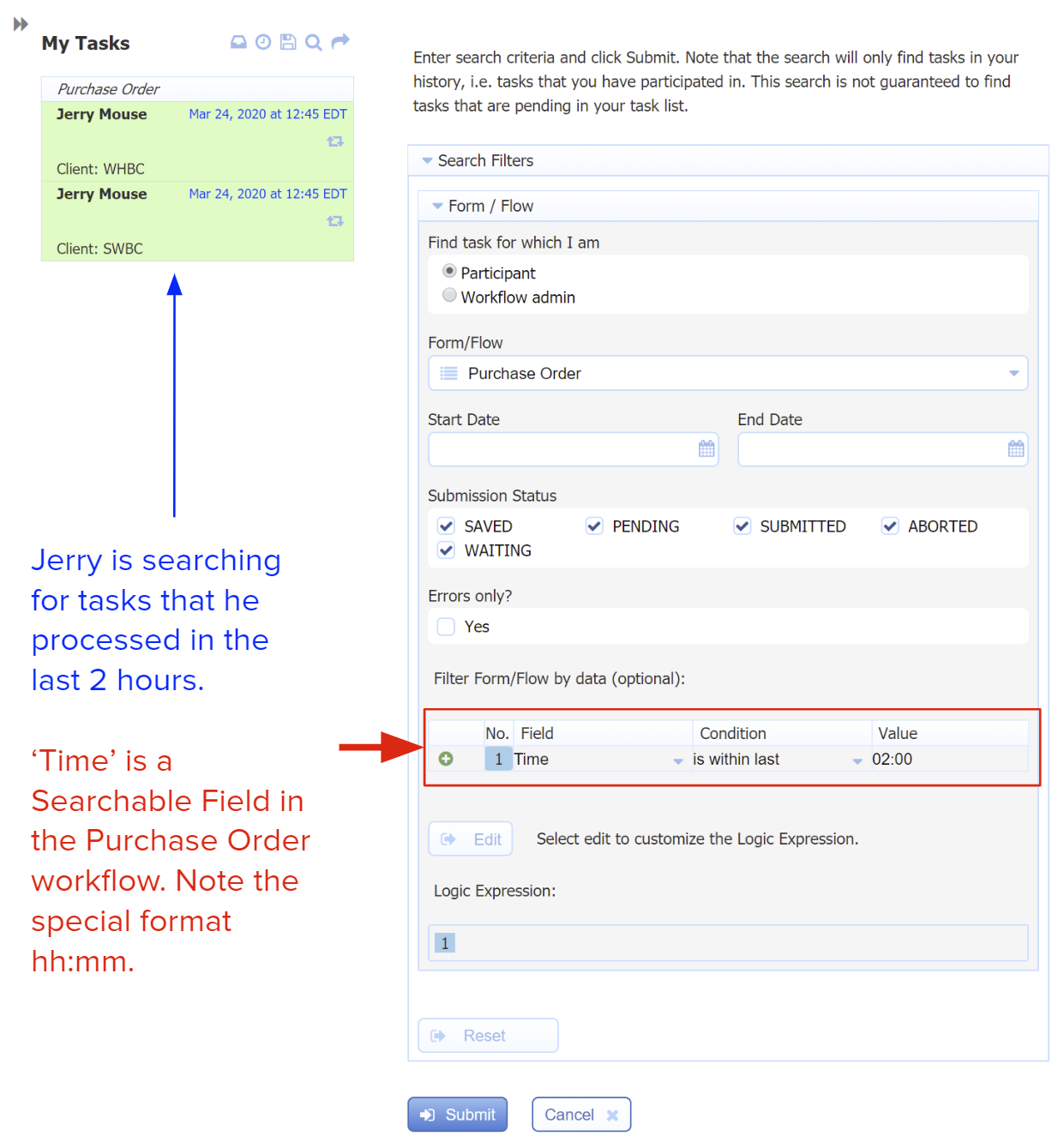
If you enter an invalid value, an error will display with instructions:
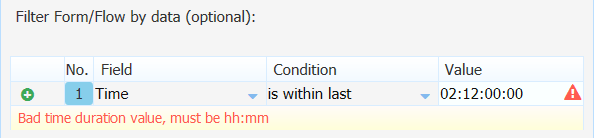
Editing the Logical Expression
If you want to modify the logical expression, click the Edit button. The logic expression becomes editable.
The Logic Expression allows you to customize and combine the filter conditions using ANDs and ORs as well as parenthesis () to group terms of the expression.
- Each filter item (expression) is represented by a letter (A for the Date range or B for the State or a number that corresponds to the row of the sub-expression in the Other Filter Items grid).
- Combine the letters and numbers using parenthesis to group items as needed.
- Build the logic of the overall predicate expression using AND and OR as appropriate.
- Click save when done to save the expression. Please correct any indicated parse errors in order to save.
Searches are initialized with the data entered as part of the previous search performed in the current web session. The one exception to that is the Filter Form/Flow by Data table which will always start out empty.
The Reset button clears all filter fields with the exception of Submission Status which is reset to all checkboxes checked.
Task List Search Example
The image shows an example of a Task search screen and the results displayed. Manager Jerry is searching for:
- Tasks in all submission states for Purchase Orders for companies named SWBC or WHBC performed between 3/1/202 and 3/31/2020.
- There is a field in the PO named Client Company that has been set up as a Searchable field.
- Workflow Admin is selected in "Find tasks for which I am". Note that if Jerry selects "Participant" he will only see tasks he has participated in, not his own pending tasks. In this example, he has been assigned Workflow Admin Access Control, so he selects Worfklow Admin in order to see all tasks, including pending tasks.
- The Purchase Order workflow is selected from the Form/Flow dropdown.
- The field named ClientCompany is selected from the Field dropdown.
- The condition for the Client Company field is contains.
- A value of SWBC is entered in the Value column on the first line.
- Jerry clicks the
 icon and adds another line where the value of the Client Company field is WHBC
 - Jerry clicks the Edit button and changes the logical expression from 1 AND 2 to 1 OR 2 and clicks Save.
- He selects the Start and End Dates and verifies that all the submission status checkboxes are checked
- He clicks Submit.
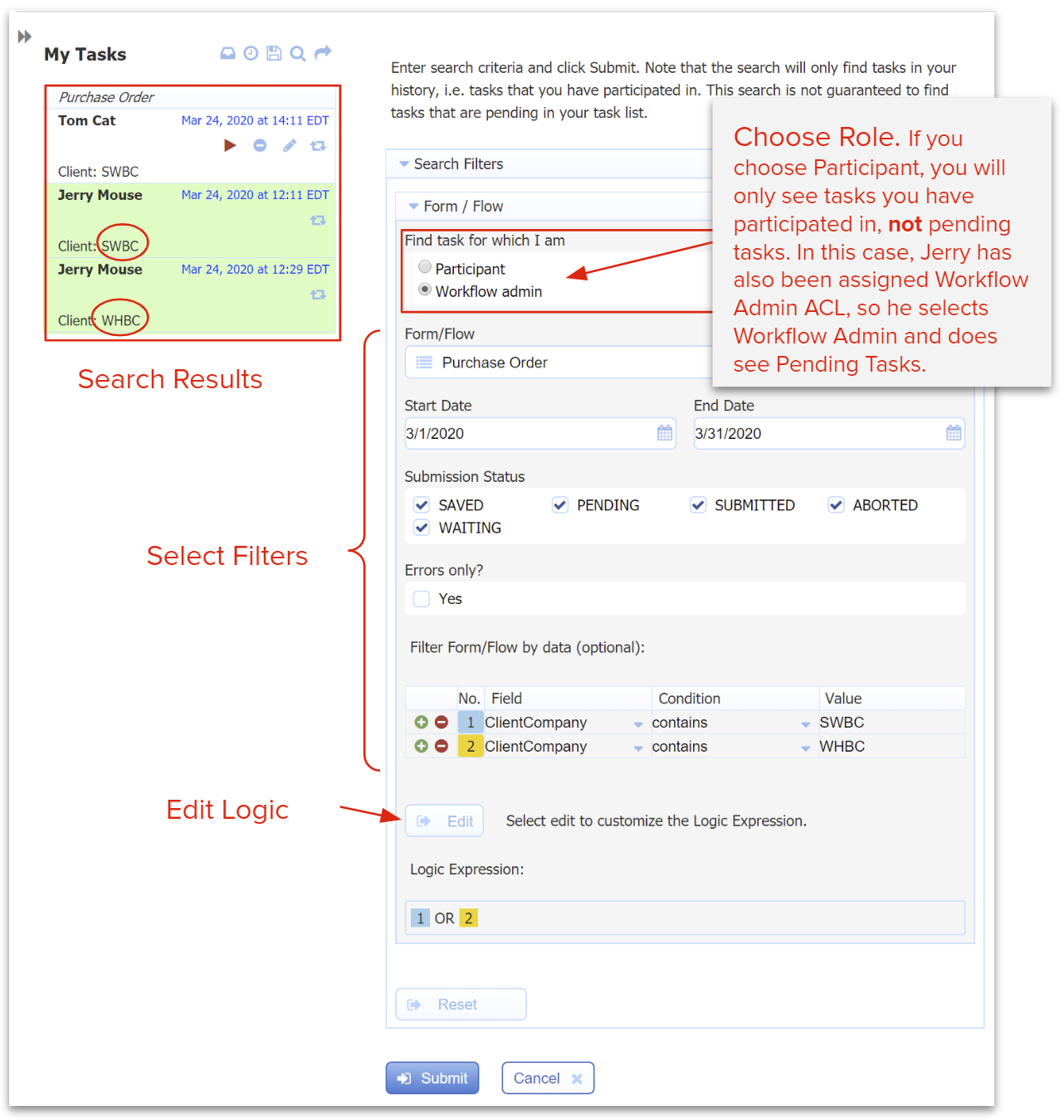
The results show a PO for SWBC currently in a pending state. Checking the Audit Trail reveals that the task is on his Task List and is locked by him.
Tenant Admins and users with flow admin permission are able to search for tasks that were performed by other users. One very common function is to search for tasks that are locked by a particular user so that the flow admin can modify them and reassign them to another user or role -- for example if a person goes on vacation and you need to move a saved or pending form or flow to another user.
If no matching tasks are found as a result of your search, you will see this message:
If a flow was renamed after having submissions, the original name will appear in the task list for tasks in PENDING and SUBMITTED status until the instance is saved.
View My Task
Users logged into are able to view workflow steps that they performed by clicking on the
 icon in the Audit trail. When you are viewing your task, you may notice the read-only view watermark. This is to remind you that you can view the information but can not make changes to it.
You will not see this icon for rejected tasks, tasks that have been reset/reassigned/aborted by a tenant or flow admin, or tasks that have been saved to your Task List.
You will only be able to view tasks that you have participated in.
Let's say you submitted a Leave Approval Request to your manager and you want to view the information that you entered. You are not sure if your manager has approved it or if your request is pending your Manager's approval (pending state).
Here is how you find it:
- Login to your
- Click on My Tasks or Task List under Important Items if you are using a
- Click the Search icon
- Select the workflow from the dropdown
- Search for your task in the Task List.
- Click the
 to display the Audit Trail
 - Click the View icon to see the data that was entered.
- Click the Audit Trail icon again to return to the Task List.
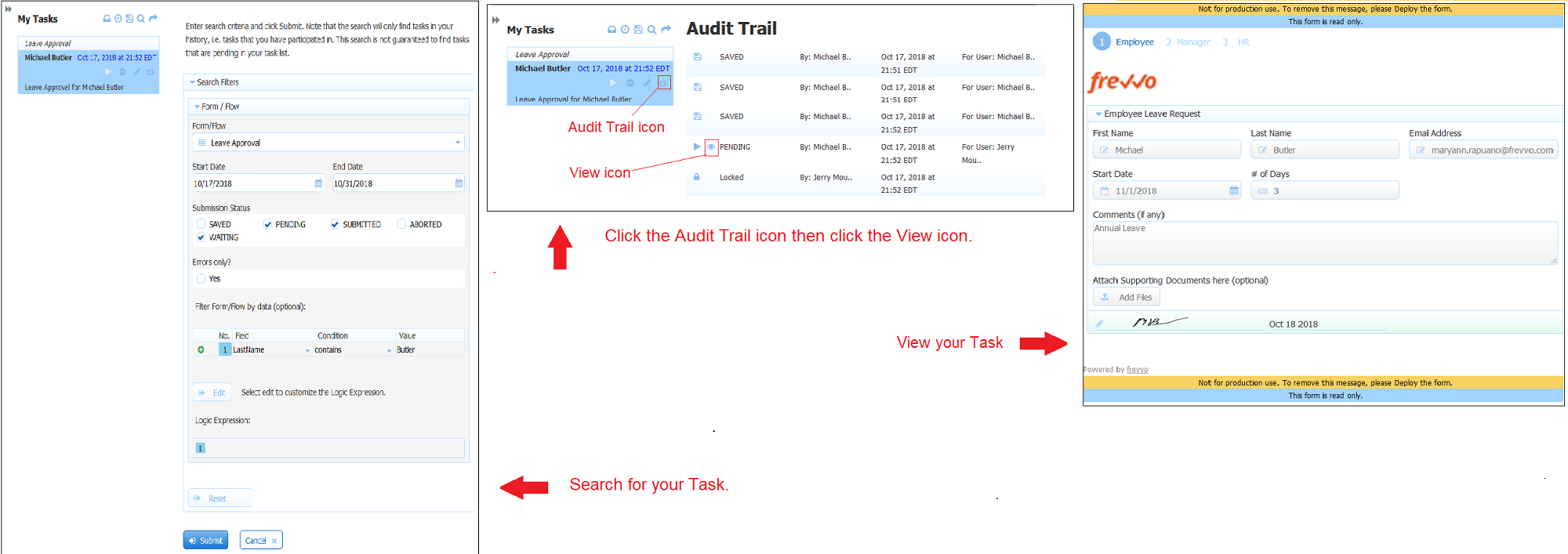
Refer to View My Task for additional information about viewing tasks when workflow steps are performed by the same user or sent to an anonymous user.
Saving forms/flows to complete at a later time
Users may not have all the information required to complete a form/flow in a single session. offers a Save/Load feature that adds a Save button to the bottom of the form: Users can partially complete forms/flows including leaving required fields blank and even having invalid data in form fields then click Save. The partially completed form is saved to the user's Task List. Later the user can re-open the form either in the same browser or a different browser or even from a different computer, and reload the partially completed form and continue working on it. You can save the form/flow as many times as you like. Clicking the
 Saved Tasks icon displays all tasks partially completed by the user. Each time the Save button is clicked is tracked by creating entries in the Audit Trail. Saved forms are not the same as submitted forms. Saved forms do not appear in the Submissions Repository. Saved forms can contain invalid data and also contain required fields with no values yet entered. When such a form is re-loaded the missing and invalid values are again flagged as such by
 . And the form cannot be submitted (the submit button will be grey'd out) until corrections are made to those fields.
Follow these steps to Save a form:
- Logon to your
- Select a form/flow from the tab you created. Fill in some parts of the form/flow but do not complete it. Click the Save button. The "Save Successful" message will display.
- Click the icon to display your Saved forms.
- Click the Perform icon. Add some more information but do not complete. Click the Save button. The "Save Successful" message will display.
- Save the form a third time then complete the form/flow.
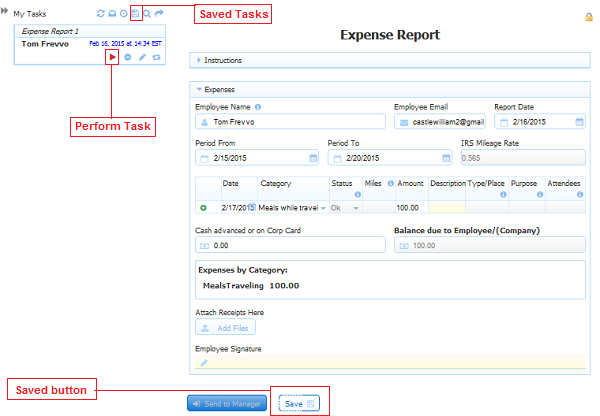
If your form/flow does not have a Save button, contact the form/flow designer.
Sending Emails in
offers the flow designer many ways to send emails from workflows. You can:
- Configure Task Notification emails - users receive an email informing them that there is a task on their Task List that requires their attention.
- Send an email when a flow is completed. This email is configured through the Doc Action wizard and can be customized.
- Send an email when one of the steps in the middle of the flow is executed. This email is configured through the Activity Doc action wizard and can be customized.
- An email is sent to a user when a task is rejected. This is an automatic function of the rejection feature and the email cannot be customized at this time.
- Escalation emails - tasks must be completed before a deadline. Designers configure the users that receive reminder emails and an email that is sent when the deadline expires.
- Route a workflow to someone who does not have a frevvo login (anonymous user) - discussed below:
The Email in the flow designer palette is ONLY used to route a workflow to someone who does not have a login(anoymous user). It does send an email to the anonymous user that contains a link to the step in the flow that the anonymous user performs. The anonymous user completes the step and then the workflow is routed back to a user who must login for the workflow to continue. Examples of workflows that would have an an anonymous email step would be a /wiki/spaces/frevvo90/pages/1063682918, or a Purchase Order that is sent to the customer for approval. Refer to the Flow Tutorial for step by step instructions to implement this feature for a Purchase Order workflow.
Clicking the link in the Anonymous Email more than Once
The link in the email sent to an anonymous user can be clicked more than once in a screenflow consisting of an Anonymous Task step followed by multiple sequential anonymous steps. The anonymous user is brought back to the flow at the current/latest anonymous step if the Save on Navigate feature is selected.For example, imagine a New Listing Agreement workflow where the Real Estate agent can elect to send an email to the seller (anonymous user) to collect the property details. In this scenario, the agent fills in steps 1 and 2 of the flow supplying the Seller's email address. The Seller receives an email with a link to the first anonymous step (Seller Information). The Seller clicks on the email link, completes the Seller Information and Property Information steps then the flow is routed back to the agent for review.
In the designer, the flow would look like this: Notice the Seller and Property information steps represent a screenflow since they are both filled out by the same person (Seller).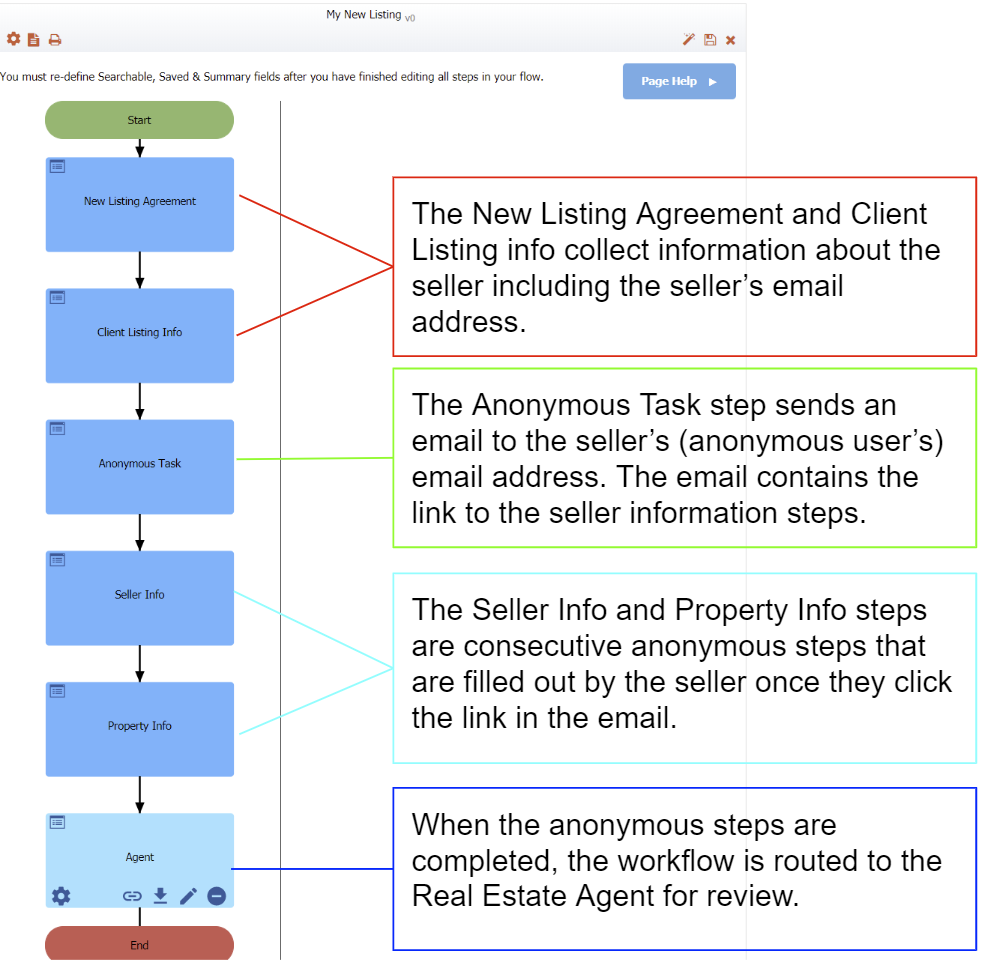
Let's say the Seller completes the Seller Information step then closes the browser. When the seller clicks on the link in the email again, the Seller will be directed to the Seller Information step.
If the Save on Navigate property is checked for this workflow then the anonymous user is brought back to the flow at the current/latest anonymous step (Property Info) when they click the email link a second time.
Workflow Behavior for Consecutive Steps assigned to the Same User
The designer defines task boundaries by setting assignments (user, role or email address), so each flow step with an assignment is considered a new task. Any subsequent flow steps without assignment are considered part of screen flow of the same task. Having an assignment to a flow step strictly enforces the task boundary and it is applicable for the first step of flow as well.
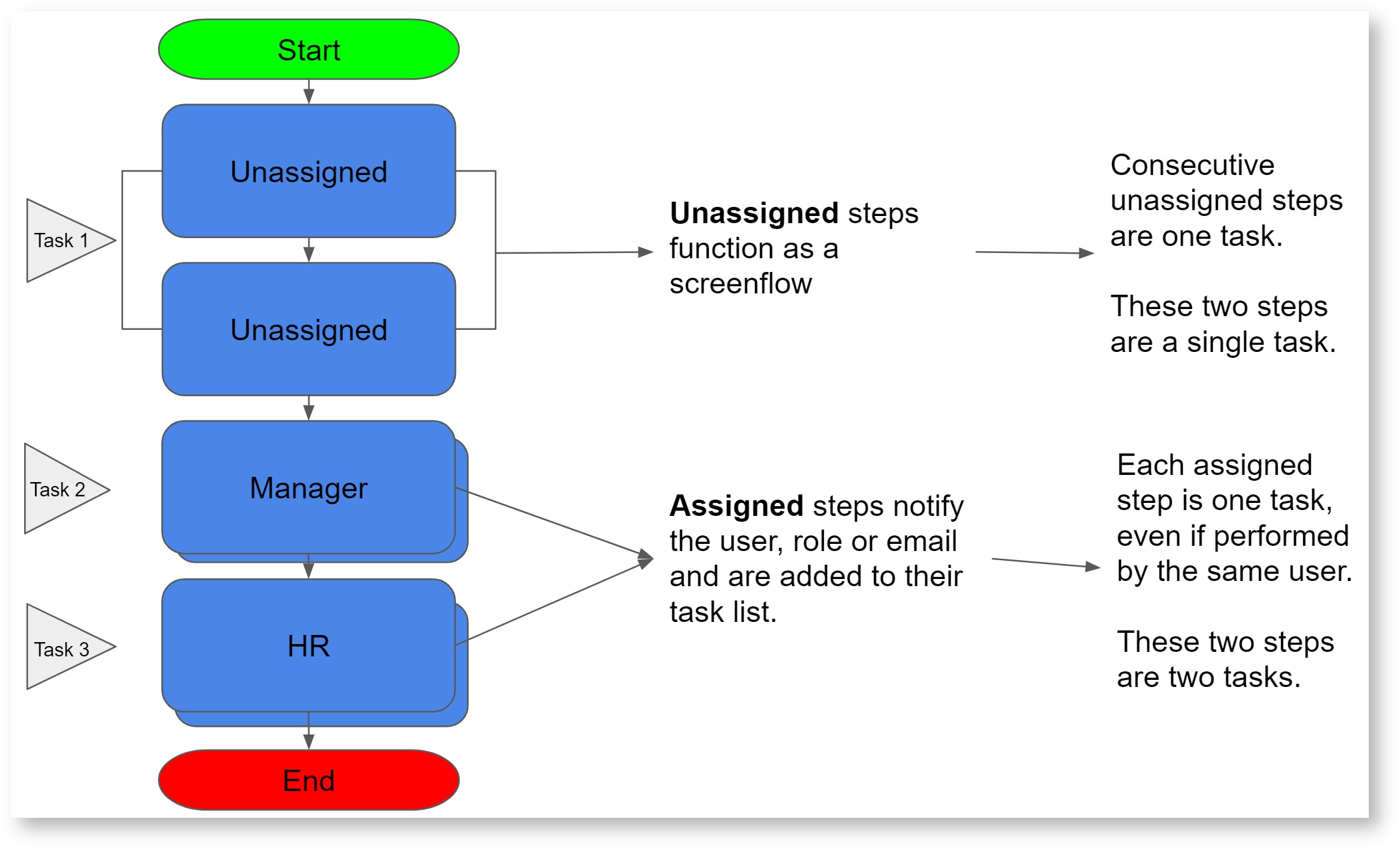
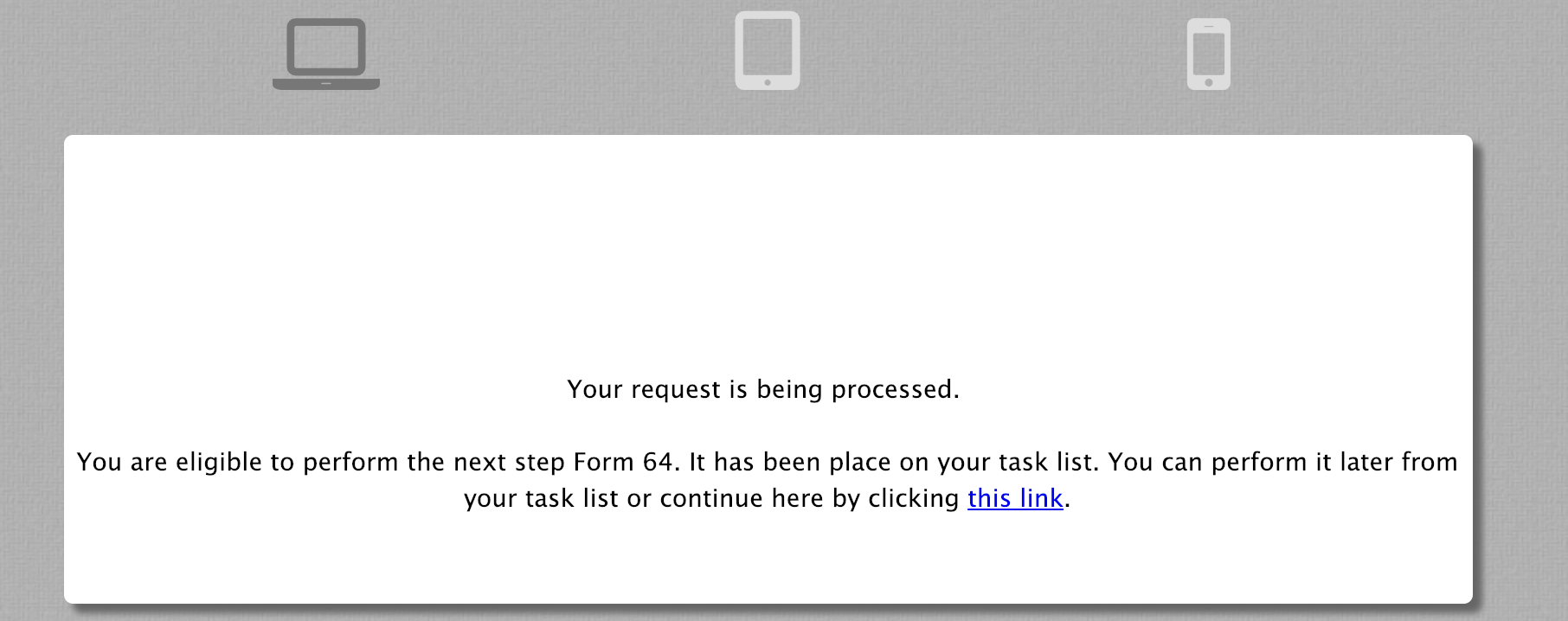
When navigating back using the navigation bar, consecutive unassigned tasks in a screenflow will be available to edit. Once a user has moved on to a subsequent assigned step, all prior steps will be read only.
Invalid Task Assignment
For workflows created in v9.0.x and later, when a task that is routed to a templatized user, role, or email resolves to null or empty string, the task will be assigned to the "invalid-task-assignment" userId and a notification with be sent to flow admin users (or the tenant admin user if no flow admin is configured.) This will enable flow admin users to easily search mis-routed tasks assigned to the "invalid-task-assignment" userId and re-assign to valid user.
Workflows created in v8.x and prior will not inherit the new "invalid-task-assignment" behavior if a templatized user, role or email resolves to null. Instead, they will retain the previous behavior of morphing into a screenflow. To upgrade a workflow to use the v9 Invalid Task Assignment behavior, you will need to manually edit the flowtype property supportNullAssignee="false".
- Download the .zip file of your workflow
- Extract the files to a location of your choice. Open the unzipped folder.
- Edit the flowtype file with a text editor.
- In the code section that begins with '<flt: FlowType' add the attribute 'supportNullAssignee="false"'

- Re-zip the workflow file.
- Upload the edited workflow .zip into a different application and test it.
- Upload/Replace the original workflow when you are ready. Follow these best practices for updating a workflow in production.
Public forms/flows with Save/Load or Digital Signatures
Anonymous users can access public forms that include the save/load feature or digital signatures. These features require a login. When the anonymous user clicks to save or sign, they will be prompted with the login screen.
Flow Processing Modes
The Navigation toolbar provides the ability for a user to navigate back and forth between the steps of a workflow. This is helpful if the user needs to return to a previously competed step to make a correction or review the entered data. Editing of previously completed steps in a workflow is no longer possible if the previous step was completed by a different user than the current user. Previously completed steps are now rendered as read only unless it is a prior step for the same user, with no intervening steps belonging to another user. This feature is referred to as View mode.
Navigating through completed steps rendered in View mode using the the Continue button, skips completed steps such as HTTP Wait Notify and anonymous Email. Configured document actions are not re-executed in View mode.
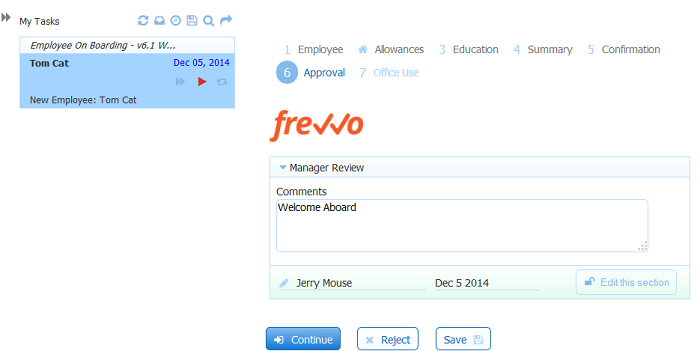
Let's consider the example of a new Employee On Boarding workflow, configured with the navigation toolbar. The first 4 steps in this workflow are referred to as a screenflow since they are all completed by the new employee. The screenflow in this example, consists of an Employee Information, W -4 Allowances, Education, Summary and Confirmation forms. New employee, Tom, realizes when he gets to the Confirmation step(4) that he needs to make a correction on the Allowances step (2).
Tom clicks the Allowance step in the navigation toolbar or the details button on the Summary step and is able to edit the data to make his correction. Tom clicks the Continue button to return to the confirmation step, signs the confirmation form then sends the workflow to his manager.
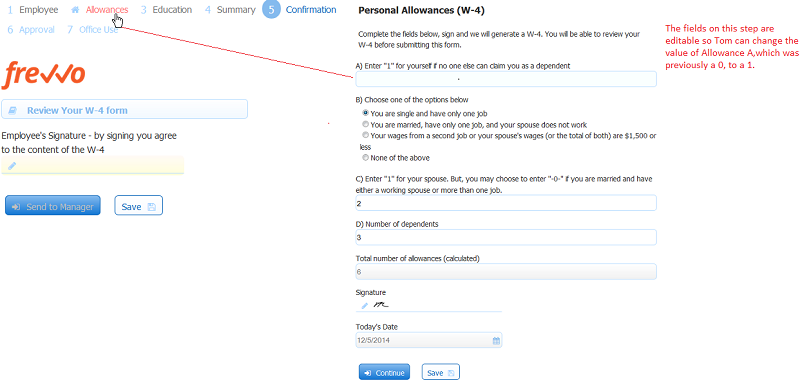
Before manager Jerry approves the workflow, he wants to review the previously completed steps to ensure all is in order. Jerry clicks on the Employee step of the navigation toolbar and is able to review the information but he will not be able to edit it.
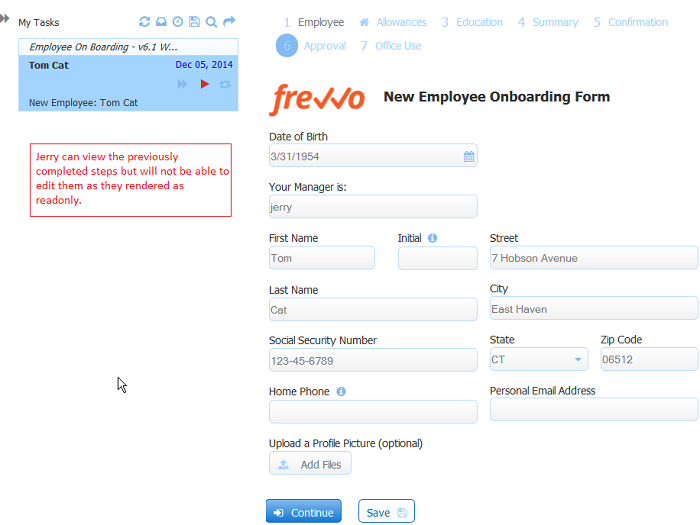
Clicking the Continue button displays the subsequent tasks in View mode and eventually brings him back to the Manager Approval step where he can approve or reject the task.